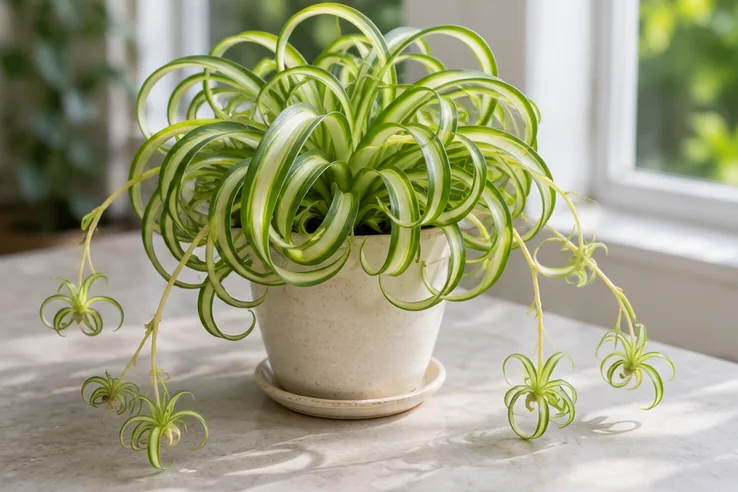
The curly spider plant ‘Bonnie’ has leaves that naturally twist and arc. Give it bright filtered light, a pot that drains and a watering routine based on the mix. Its curl alone tells you little about whether the roots need water. Check the medium and watch for changes in the overall condition of the plant.
‘Bonnie’ is a cultivar of Chlorophytum comosum. It can make long shoots with smaller plants attached. Those plantlets give you a simple way to start another curly spider plant and are useful when the original pot is getting crowded.
Use the tag to tell a cultivar curl from a care problem
Look at several leaves. On ‘Bonnie’, the curl and variegation are part of the selection. Younger leaves may look different while they develop. Keep a photo of the plant when it is in good condition so you can compare the normal look with a sudden change.
If tips turn brown or entire leaves become limp, check the mix and the recent exposure. Compare damage on older and newer leaves and see whether it is concentrated in the leaves closest to a window. Observe the whole plant. Normal curls along a healthy leaf differ from a tip that has dried or a leaf that has lost its firmness.
Make sure the plant has a clear label if you have several spider plants. If someone gave you a plantlet, ask what the parent looked like. Curl and striping combined with the name can help you distinguish the named cultivar from related selections that have straighter leaves.
Give the leaves room and filtered light
Place the pot where bright light reaches it without the strongest direct sun. If you move it to a brighter position, do it gradually. The youngest leaves and the drying rate tell you how the plant responds. Keep the foliage away from active vents and places where it rests against hot or cold glass.
Give the leaves room to arch over the sides. A hanging pot or a shelf can show the foliage well. Check how you will lift and drain the pot. Consider where runners and plantlets will hang after they develop. The ASPCA lists Chlorophytum comosum as non-toxic to cats and dogs, a useful species check when deciding where to put the pot.
Move the pot if the best light falls at a spot where it is hard to water safely. A bright portable container can be practical if the holder is stable and properly supported. Take a look at it once a week while conditions are changing, then adapt how often you check.
Water after you check below the surface
Use a well-drained potting mix and a container with drainage. Water when the mix has dried sufficiently and let the excess escape. A warm bright space can dry a small pot quickly. Check deeper in the mix before watering again, since the top can dry faster than the center.
Spider plants develop thick roots. If they crowd the pot or push the plant upward, assess whether repotting is due. Match the new container to the roots and use fresh potting mix suitable for the plant. Check the moisture during the first few cycles, as the new combination may behave differently.
Brown tips can occur with different stresses. Wisconsin Extension identifies water quality and other conditions as potential contributors. Review inconsistent watering, accumulated salts, the plant’s environment and whether the issue continues on new leaves. Trimming a dry tip may improve appearance while you investigate what changed.
Root a plantlet and keep the cultivar name with it
Choose a developed plantlet on a runner. Follow propagation guidance from an established source. You can place the plantlet on suitable mix in a neighboring pot while it is still attached, then separate it once it roots. Position the pots so the connection stays relaxed and the plantlet does not pull free when you move them.
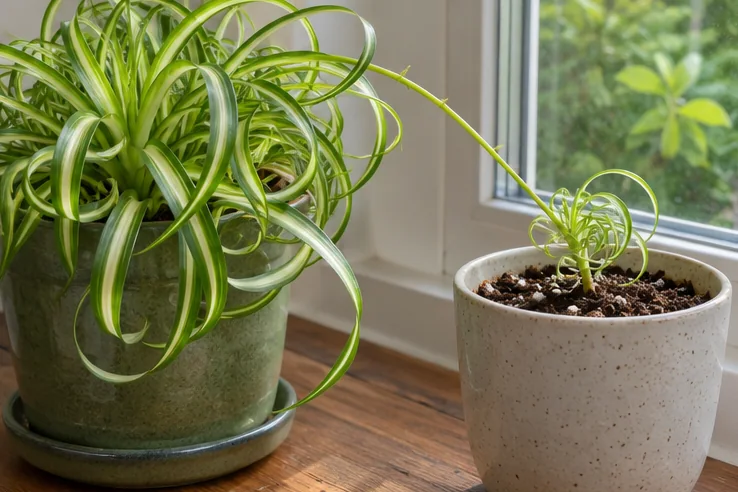
Alternatively, separate a developed plantlet when it is ready and place it in suitable medium. Hold the plantlet gently at its base so you don’t have to pull on the leaves. Keep the medium appropriately moist while roots establish and give the new plant filtered light. A tiny new root system has different needs from a mature pot.
Label each plantlet as it roots. If it goes to another household, include the botanical name and cultivar. The ASPCA lists the species Chlorophytum comosum as non-toxic to cats. A clear name is useful when a home has several plants or names are shared between species.
Watch new growth to see what the plant needs
Compare the condition of the newest leaves over a few weeks. Check how quickly the mix dries and whether the shoots have room to extend. A plant with firm, healthy new foliage and a stable drying cycle generally needs small adjustments as seasons change. Let those observations guide care before interpreting every curl as a problem.