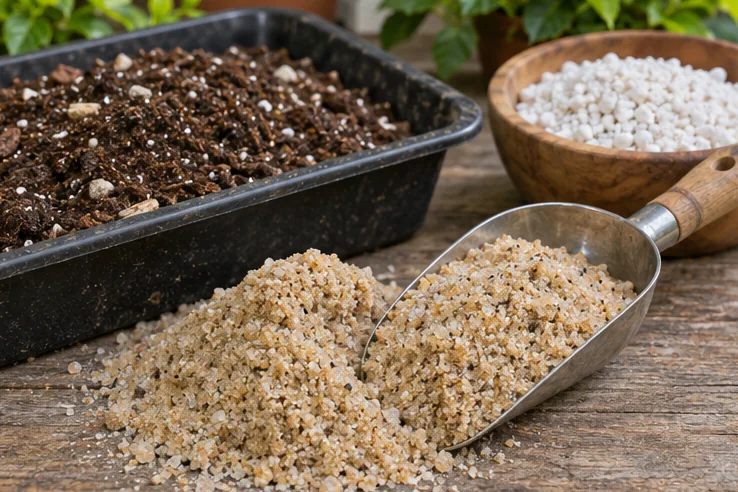
Horticultural sand is a coarse mineral material used in some container and propagation mixes. Look for reasonably coarse particles, a washed product and a label that describes its gardening use. The term does not identify one consistent grade across suppliers. Ask what the product contains and how large the particles are if the bag gives you only a name.
Use the sand when a recipe calls for it for a specific reason, such as creating a suitable rooting medium. For a heavy garden bed, start with the soil and drainage problem. Mixing in a small amount of sand rarely changes a heavy soil into the open blend people expect.
Look at the particles before judging the product
Rub a little coarse sand between your fingers. It should feel gritty, with individual grains you can see. A product rich in fine dust fills smaller spaces in a mix. The amount of fine material and the mix of grain sizes can affect how the full blend behaves. Ask for the grading or examine a sample rather than interpreting “sharp” or “horticultural” as a size guarantee.
Look for a washed product intended for horticultural use and check whether its salt content is suitable. Sands from construction, play or other uses are sold for different purposes and may have unsuitable grading or other properties for the blend you want. Match the grade and material called for in a reputable recipe. Terms and product options vary by market.
Put a small amount on a pale plate if you want to compare supplies. Examine the largest and smallest pieces, and see whether there is significant dust. Read the label alongside the sample. Appearance gives you information about size and color. The label or supplier provides information about origin, intended use and any processing.
Use it as one part of a container blend
The Royal Horticultural Society includes suitable coarse mineral materials in some potting and propagation mixtures. In a container, the ingredient works alongside the rest of the blend. The plant needs air and water around its roots, and how the particles fit together affects both. A small addition may have little effect in a mix that stays densely packed or in a pot without drainage.
For cuttings, identify what the plant requires before choosing a medium. Some semi-ripe cuttings use a mixture with a coarse material to provide an appropriate balance of moisture and drainage. Look for a recipe from a source you trust, then match the product it specifies. Keep cuttings in conditions suitable for that plant while their roots form.
Check the weight too. Sand adds mass to a pot. That can be helpful where a small pot needs stability and inconvenient if you frequently move the container. A position on a high shelf or other support deserves a check of the container’s full wet weight and whether the support is appropriate.
Compare grit and perlite for the actual task
Horticultural grit generally refers to coarser mineral particles. Use the product size rather than expecting all grit to be identical. It can provide a different texture in mixes that specify larger mineral pieces. It also adds weight.
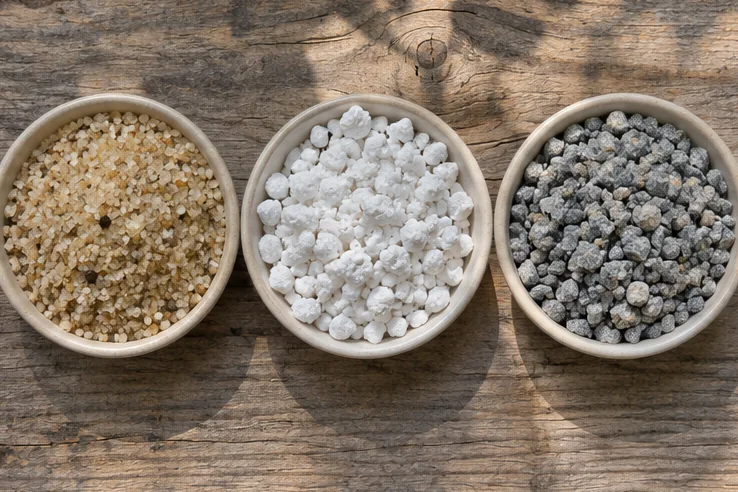
Perlite is a lightweight expanded mineral used in many gardening mixes. It occupies volume with less weight than a similar volume of dense sand. For a recipe calling for perlite, check before substituting a heavier or much finer material. The water and air behavior of the completed blend can change.
Try a small batch of a recommended mix if you want to compare two available products. Use the same style of container and observe how readily water exits, how the medium settles and how long it stays wet. Test it before potting a large set of plants. Check the needs of the plant alongside the container behavior.
Treat in-ground clay as its own question
Field soil has an existing texture and structure. A little sand can settle among smaller clay particles and may do little for drainage or even contribute to a denser mixture. The appropriate response depends on why the site is wet or compacted and what you want to grow there.
Check where the water comes from and how long it remains after rain. Find out whether there is a compacted layer, a low grade or runoff from another part of the property. NC State Extension’s soils guidance offers a starting point for understanding texture and site limitations. A soil test can give other useful information when the goal is to improve a bed.
A narrow strip of plants might be better located on naturally more suitable soil. A large drainage problem near a building may need professional assessment. Decide what the site requires before buying a material meant for container recipes. If you can identify both the plant and the intended medium, it is easier to tell when horticultural sand is the right purchase.