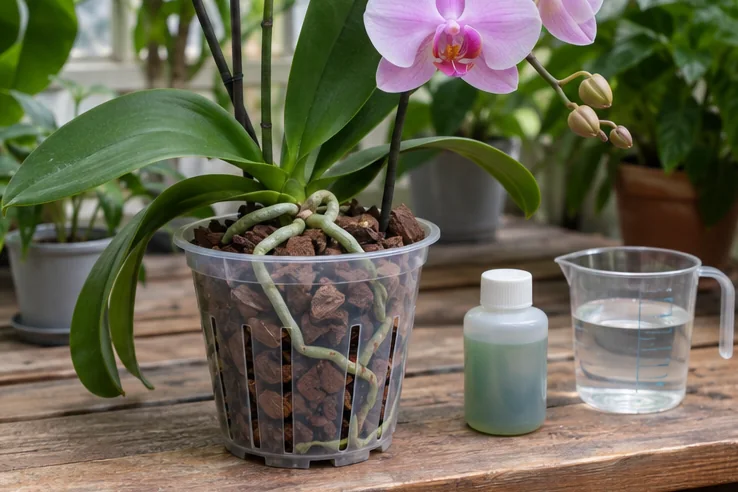
Start with the kind of orchid you grow, the condition of its roots and whether it is actively making leaves or roots. Use a fertilizer with clear instructions for orchids and measure the dilution. For a common moth orchid, a dilute feeding program may suit the plant during active growth. The exact interval and strength depend on the plant, its medium, water and the label.
If an orchid has stopped growing and the pot never dries, inspect the roots before trying to correct the problem with fertilizer. Feeding changes the nutrients in water. It cannot restore air to a waterlogged mix or replace healthy roots.
Match the product to the orchid and medium
Find the plant label. A moth orchid, Phalaenopsis, is a common starting point and has specific guidance available from the American Orchid Society. An orchid of another group may have a different growth cycle or a different way of storing water. Use its care guidance before copying a schedule.
Check whether the plant is growing in bark, moss or another medium. The mix affects how much water stays, how quickly it drains and how often you will be applying any solution. If you have recently repotted, watch how the pot behaves through several waterings before deciding on a regular program.
Read the fertilizer label for intended uses, mixing instructions and directions for the watering frequency. The familiar three numbers describe nutrient percentages, and higher figures in one position do not establish that a product improves blooming in every setup. Choose a formula suited to your plant and culture conditions using reputable care guidance.
Measure a solution you can repeat
Decide how much water you will use. Check whether the instructions specify an amount per gallon, per quart or another unit. Use a clearly marked container and a measuring tool appropriate to the product. Track the form of the fertilizer as well. A scoop for one powder may hold a different quantity from a scoop for another.
For example, if the label calls for one teaspoon per gallon, use half a teaspoon to make a half gallon at the same strength. This illustrates proportional mixing. Use the rate and frequency specified for your actual product and plant. When following a culture guide that recommends a weaker solution, make sure the volume, rate and interval are consistent with its advice and the label.
Write down the mix if you are using several containers or fertilizers. A note with the amount of product and volume of water lets you reproduce the decision. Measure in dedicated equipment and follow the label’s handling and storage instructions. A plant that got less solution because a pitcher ran out may still have received the same concentration as the others.
Feed during growth and keep plain water in the routine
Look for a new leaf or fresh root tips. These give you a clue that the orchid is growing. A regular low-concentration program is described by the American Orchid Society for suitable conditions. Adapt to the type of orchid and the frequency with which the pot needs water.
Clear water applied periodically can help flush accumulated dissolved salts when it can run freely out of the container. Follow the culture and product guidance. Bring the pot somewhere it can drain, and avoid leaving it in runoff inside a decorative pot. Review the quality of the water as well if deposits keep appearing.
Fertilizer can add to the dissolved salts already in your water. A white crust can be a reason to inspect both inputs and the drainage. Check root tips and look at the condition of the medium. The American Orchid Society’s salt toxicity guidance explains symptoms and conditions that can contribute to accumulation.
Check roots before responding to slow growth
For a moth orchid, look at the roots that are visible. A firm silver root may be alive and dry. Soft roots, persistent wetness or older material breaking down warrant closer inspection. If the plant cannot take up water normally, a stronger solution is a poor first response.
Look at recent light, temperature and water changes. The plant may be in a period of slower growth. If you recently moved it, note when growth stopped or when roots began looking different. Give root condition and reasonable light priority before choosing a different formula.
If several pots share a watering routine but only one shows signs, examine how its medium and container differ. A moss-filled pot and a bark-filled pot can use the same fertilizer differently because they need different watering intervals. Use the plant in front of you as the guide.
Review the routine after several waterings
Record when you use fertilizer, when you use plain water and what changes in roots and leaves. Keep the rate measured and make adjustments for the season or growing activity. If the program becomes hard to repeat, simplify it around a clearly labeled product and an appropriate culture guide. Consistency helps you see whether a change in care is helping.