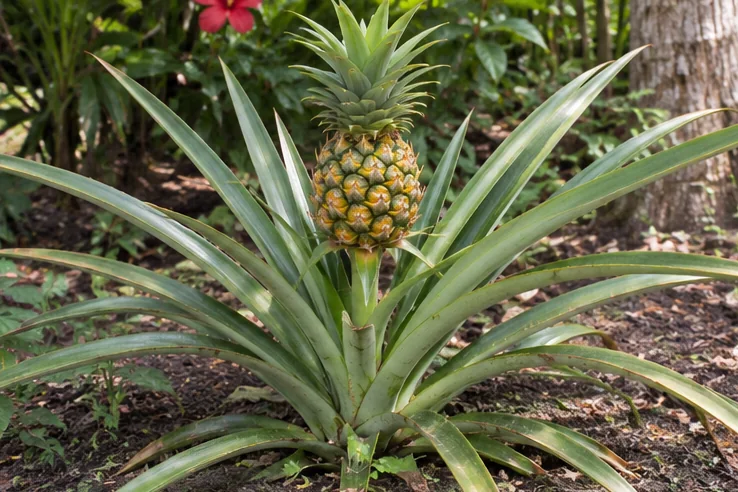
A pineapple plant looks like a low fountain of stiff, pointed leaves. The leaves grow in a circle from a short central stem, forming a shape called a rosette. When the plant flowers, a stalk rises from the center. The flowers sit close together on that stalk, and the developing fruit eventually has a tuft of leaves on top.
Pineapple, Ananas comosus, is a ground-rooted bromeliad in the same plant family as air plants. The fruit sits above the foliage on a central stalk. Before that stalk appears, most of what you see is the plant’s leafy base.
Before flowering, look at the rosette
Viewed from above, the leaves appear to radiate from a central point. The youngest leaves are close together toward the center, and older leaves extend farther out. Their pointed ends and strap-like shape make the whole plant look spiky even if the margins of a particular cultivar are relatively smooth.
Leaf edges can have small spines, and the degree of spininess depends on the variety. Observe before touching. If you are comparing nursery plants, use the whole arrangement of the leaves as your first clue and use the edge as a supporting detail. One badly damaged leaf gives you less information than several healthy ones.
A young plant started from a pineapple crown can look like a small version of the leafy tuft you removed from the fruit. As new growth comes from the middle, the base becomes wider and the longest leaves arch outward. A plant at this stage can be leafy for a considerable period before a flower stalk is visible. Growing conditions affect the timing.
Other plants can have a similar pointed outline. If you are deciding between an unlabeled pineapple plant and an agave-like specimen, take a view of the entire plant, a view from above and a close one of a leaf margin. A flower stalk, known plant source or nursery label is useful when the rosette by itself is ambiguous.
Flowering begins in the middle
A tight developing flower cluster emerges on a stalk from the center of the rosette. Botanists call this arrangement an inflorescence. It can look like a small knobby cone with leaves crowded below it. Look into the plant from the side. The cluster stands out more clearly from the pointed leaves at that angle.
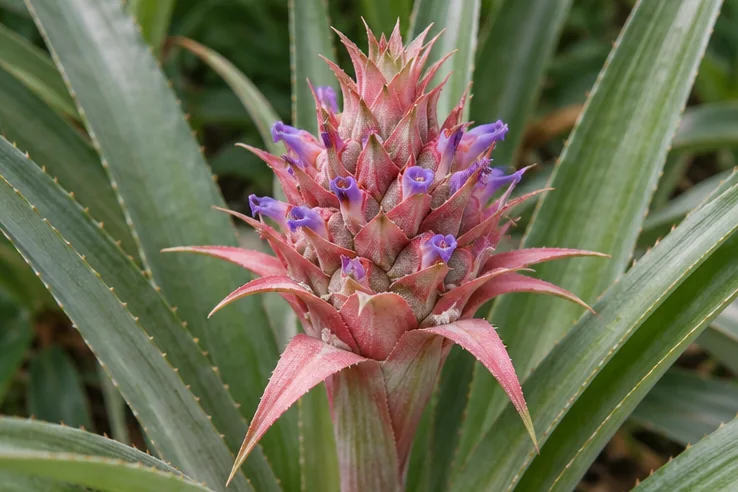
Individual pineapple flowers open among the small structures that make up the cluster. UF/IFAS describes the pineapple fruit as a multiple fruit. In this case, fruitlets from many flowers develop together and merge into one larger structure. The outlines of those units contribute to the recognizable pattern on the outside.
In a garden, the stalk shows you which rosette the fruit is growing from. Start at the rosette, follow the central axis upward and look for the developing cluster. A fruit sitting deep inside the leaves can seem to be attached directly to the ground until you look from low on the side and see the stalk supporting it.
The fruit and its crown look like two different layers
As the fruit becomes larger, its outline becomes more familiar. The lower part is the growing fruit with its repeated surface pattern. Above that sits the crown, a leafy shoot shaped like a small rosette. It grows from the top of the fruit while the entire fruit remains attached to the stalk below.
A supermarket pineapple with its crown intact shows both layers clearly. Set the fruit upright to model the position it held on the plant. Outside, the base rosette would spread away from the stalk below the fruit. The tuft on top is smaller and looks like a second plant from many viewing angles.
Fruit size, shape and color vary. If you are taking identification photos, include the attachment to the stalk and the top crown. The details of leaf placement and fruit attachment matter more for recognizing a pineapple plant than a prediction based on the fruit’s current skin color.
Look for shoots around the fruiting plant
Pineapples can make shoots in several places. Some appear near the base or along the plant, while others may develop on the stalk below the fruit. The crown, by contrast, is attached above the fruit. UF/IFAS describes the different plant parts that can be used for vegetative propagation, growing a new plant from an existing plant piece.
A fruiting shoot generally develops one primary fruit. If there are several rosettes in a dense planting, follow each one back to the point where its leaves emerge. A smaller shoot growing beside a harvested plant may make another fruit later as it matures. The cluster can include shoots at several growth stages.
Identify it at a glance
First check for the stiff low rosette and the short base. On a flowering specimen, trace the stalk back to the center of the rosette. On a fruiting plant, look for the patterned fruit body and its small leafy crown. If the plant was harvested, look at the older center and nearby shoots for the next clues. The same plant can move through each of these looks as it grows.