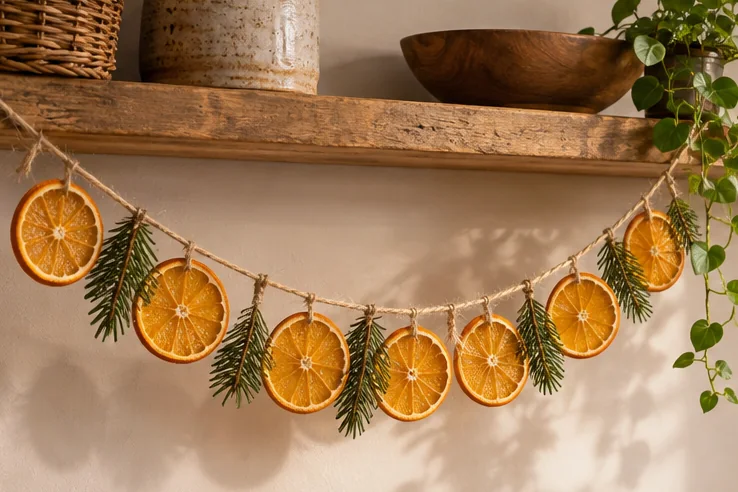
A dried fruit garland is a strand of fruit pieces threaded or tied onto cord and used as decoration. Orange rounds are a common choice because their sections form a visible pattern and the dried slices have warm color beside greenery or plain wood. You can make a short strand for an open shelf or repeat the pattern along a table or doorway.
Most home projects use sliced citrus, though some decorative arrangements use other dried fruit or whole dried pieces. The instructions here are for hanging ornaments. Set aside the selected slices, cord and any added pieces as craft materials.
Choose the fruit and the place first
Look at the space where the garland will hang. A shelf calls for a short strand with a shallow dip. A broader wall may fit several groups of slices with space between them. Lay a length of cord in the intended curve and mark the attachment points. Allow extra at each end for making loops or tying it in place.
Select fruit with intact skin and a shape that gives you several usable slices. An orange cut across its width shows the familiar arrangement of segments. Fruit of similar diameter will give a regular pattern. A few smaller rounds can add variation near the ends or between groups. Reject damaged or spoiled fruit before cutting.
Decide whether you want dried fruit by itself or a mix with other decorative pieces. Leave space when you plan to see the shape of each slice. Lay out a rough arrangement on a tray and view it from arm’s length. A pattern that looks dense on a flat surface may look lighter on a strand with a gentle drape.
Dry slices evenly
For oven-dried orange decorations, Clemson Extension suggests slices about ⅛ inch thick. Blot the juice, then lay the slices on a parchment-lined baking sheet with room between them. Set the oven to 175°F or the lowest available setting up to 200°F.
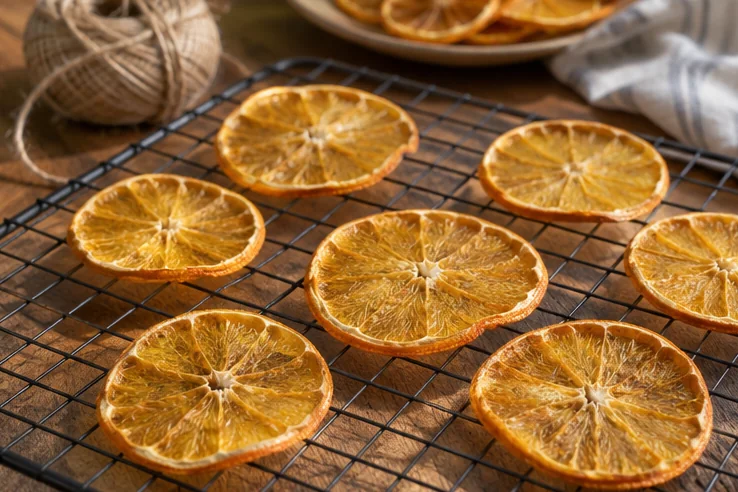
Turn the slices every 30 minutes and check their progress. Clemson estimates about three to five hours in its oven directions. Juicy or thick pieces can take longer. Handle the hot tray with oven mitts and keep cord and other ornament supplies away from the oven.
Look at the center of the slice as well as the edge. The peel can feel dry before the center does. A finished piece should feel dry through its thickness once it has cooled. Set aside anything that is still damp. Continue drying sound pieces according to the directions, and discard pieces showing mold or spoilage.
Let the slices cool before stringing. Spread them out until you have had a chance to inspect both sides. This also gives you time to sort by size and move fragile slices away from the positions that will carry more tension when the strand hangs.
Thread the garland in groups
Lay the sorted pieces on the table in the order you want. Make the first group near one end, leaving enough bare cord for hanging. Use a pointed tool to make a hole in a sturdy part of the dried slice, wide enough to pass the cord through. The center of a very thin segment can tear while you thread it. Use care with pointed tools and keep them flat on the work surface when you are finished.
Slide the round into place and repeat with the next one. If pieces move too freely, a small knot or an attachment suited to your cord can help space the groups. Keep the weight in mind if you add other objects. Support the material in several places for a long strand and secure it to appropriate hangers.
Lift the strand before tying off the last end. Turn any slices that face the wrong way and adjust the spacing. Look at it where you will see it most often. A group of slices that sits crooked when held straight may hang the way you want once the cord is gently curved.
Display it in a dry place
Hang the garland where it can stay dry and out of reach of curious children and pets. Keep dried fruit, cord and any added greenery away from open flame and hot fixtures. Choose a dry location if you want to keep the fruit in good condition. A damp window or regular cooking steam can change how the pieces feel.
Check the strand occasionally for softening or mold. Remove and discard affected pieces. If you plan to reuse the decorations, take the strand down when it is dry and store it in a way that protects the slices from moisture and pressure. Inspect it again before hanging it next time.
A short test strand is a good first project. Dry a tray of slices, hang a few in the intended spot and watch how they look in the room’s light. Once you are happy with the size and spacing, repeat it across a longer cord.