These flowering plants are native to parts of Africa, with an emphasis on southern Africa and the species documented by the South African National Biodiversity Institute. A Cape shrub from a seasonally dry site has different needs from a forest lily or a plant of summer-rainfall grassland. Use the plant’s native habitat as a clue, then check how it fits your own light, soil and winter weather.
Proteas, pincushions and heath
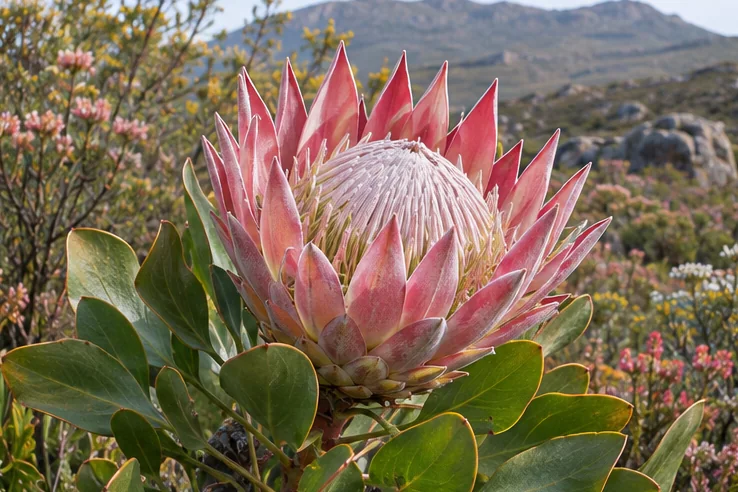
1. King protea, Protea cynaroides
A broad head of small flowers sits inside conspicuous stiff bracts. Give this South African shrub light, air and the drainage suited to proteas.
2. Sugarbush, Protea repens
Look for upright flower heads on a woody shrub. It occurs in Cape vegetation and needs space to show its branch and flower forms.
3. Oleander-leaf protea, Protea neriifolia
Dark hairs around the bracts can give the flower head a fringed edge. Look for it in reference accounts of the Cape mountain flora.
4. Pincushion protea, Leucospermum cordifolium
The projecting styles give the rounded flower head its pincushion appearance. This is a Cape plant associated with well-drained growing sites.
5. Sunshine conebush, Leucadendron salignum
Colorful bracts around the flower heads give the shrub much of its show. Different cultivated selections can look quite different from one another.
6. Fire heath, Erica cerinthoides
Clusters of tubular flowers stand out along its branches. SANBI describes a broad distribution in southern Africa compared with many narrowly distributed Cape heaths.
Bird-of-paradise flowers and lilies
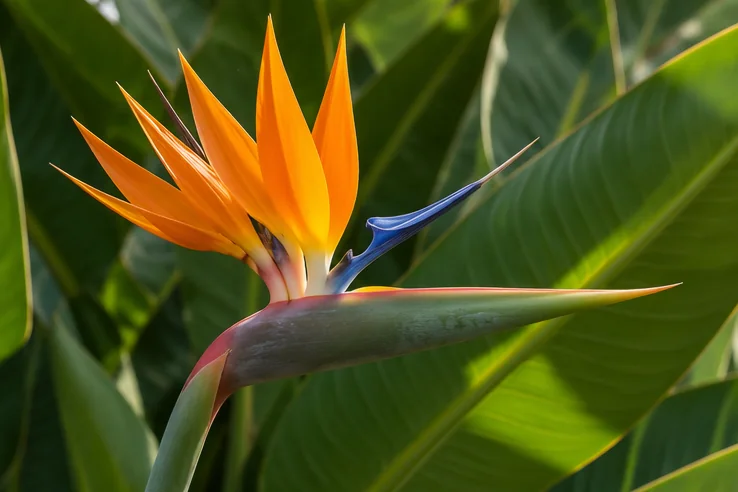
7. Bird of paradise, Strelitzia reginae
Orange and blue floral parts rise from a pointed bract. This South African species is widely grown where warm conditions suit it.
8. Mountain strelitzia, Strelitzia caudata
Broad leaves and large pale flowers with blue details sit on a tall plant. It grows in parts of southern Africa, including mountain or forest settings.
9. African lily, Agapanthus africanus
Look for rounded clusters of blue flowers above straplike leaves. The species has a Cape distribution and differs from many garden hybrids sold as agapanthus.
10. Bush lily, Clivia miniata
Clusters of orange flowers sit above broad green leaves on the familiar form. Its forest habitat gives you a clue to its preference for shelter from intense sun.
11. Natal lily, Crinum moorei
Tall stems carry pale pink or white lilylike flowers. It comes from eastern South Africa and suits a garden spot where you can accommodate its large leaves.
12. White paintbrush lily, Haemanthus albiflos
A brushlike white flower cluster rises near thick leaves. Look for this species in the SANBI accounts of shaded habitats.
Pelargoniums and daisies
13. Zonal pelargonium, Pelargonium zonale
A dark area can mark the rounded leaf. The upright flowering species is native to parts of South Africa and is related to common bedding selections.
14. Ivy-leaved pelargonium, Pelargonium peltatum
The ivy-shaped leaves grow on spreading stems that can trail over the side of a container.
15. Rose-scented pelargonium, Pelargonium graveolens
The leaves are strongly scented and the flowers are relatively small. It occurs in southern Africa. Verify the botanical name when buying a scented pelargonium.
16. Ground pelargonium, Pelargonium capitatum
Low stems can spread across the ground and carry leaves with a rose-like scent. SANBI describes the species in coastal parts of South Africa.
17. Trailing gazania, Gazania rigens var. leucolaena
Daisylike heads sit above low spreading growth. Use the full name when looking up this coastal South African form.
18. Cape marguerite, Dimorphotheca ecklonis
Pale rays surround a darker center in a familiar form of this species. It comes from South Africa and appears in gardens under more than one botanical label.
19. Trailing African daisy, Arctotis stoechadifolia
Pale flower heads and grayish foliage are useful recognition clues. The species occurs in sandy coastal settings along parts of the South African west coast.
20. Namaqualand daisy, Dimorphotheca sinuata
The orange or yellow flower heads open in bright conditions. This annual is associated with seasonal flower displays in the drier west of southern Africa.
Irises, corms and succulents
21. Parrot gladiolus, Gladiolus dalenii
An upright spike carries strongly patterned flowers. The species has a wide African distribution and appears in several colors or markings.
22. Freesia, Freesia refracta
Look for a scented, one-sided arrangement of pale flowers on a stem. Freesias grow from corms, which are swollen underground stems.
23. Cape bugle-lily, Watsonia borbonica
Tall flower spikes rise above swordlike leaves. The species occurs in Cape habitats and can provide a strong upright shape in a suitable setting.
24. Harlequin flower, Sparaxis grandiflora
Broad, showy petals open on a corm-grown plant. The named subspecies from the SANBI profile belongs to the winter-rainfall Cape flora.
25. Baboon flower, Babiana nervosa
Purple-toned flowers stand above pleated leaves. Look for this corm plant in descriptions of the southwestern Cape.
26. Large wild iris, Dietes grandiflora
The white flowers have colored markings and sit above narrow leaves. This southern African species is often planted where its foliage can form larger clumps.
27. Cape aloe, Aloe ferox
Tall branched flower stalks rise above thick, toothed leaves. Give the plant room well away from a narrow passage.
28. Krantz aloe, Aloe arborescens
Clumps of branching stems carry rosettes and upright flower spikes. The plant occurs across several parts of southern Africa, including rocky settings.
29. Red-hot poker, Kniphofia porphyrantha
A dense spike of tubular flowers is characteristic. SANBI describes the species in southern African grassland.
30. Jade plant, Crassula ovata
Small star-shaped blooms can appear above the thick rounded leaves. This southern African succulent needs an appropriately draining site and protection from unsuitable cold.
References
- South African National Biodiversity Institute, PlantZAfrica Species Index
- SANBI, Protea cynaroides, P. repens, P. neriifolia, Leucospermum cordifolium, Leucadendron salignum and Erica cerinthoides
- SANBI, Strelitzia reginae, S. caudata, Agapanthus africanus, Clivia miniata, Crinum moorei and Haemanthus albiflos
- SANBI, Pelargonium zonale, P. peltatum, P. graveolens and P. capitatum
- SANBI, Gazania rigens var. leucolaena, Dimorphotheca ecklonis, Arctotis stoechadifolia and Dimorphotheca sinuata
- SANBI, Gladiolus dalenii, Freesia refracta, Watsonia borbonica, Sparaxis grandiflora subsp. grandiflora, Babiana nervosa and Dietes grandiflora
- SANBI, Aloe ferox, A. arborescens, Kniphofia porphyrantha and Crassula ovata