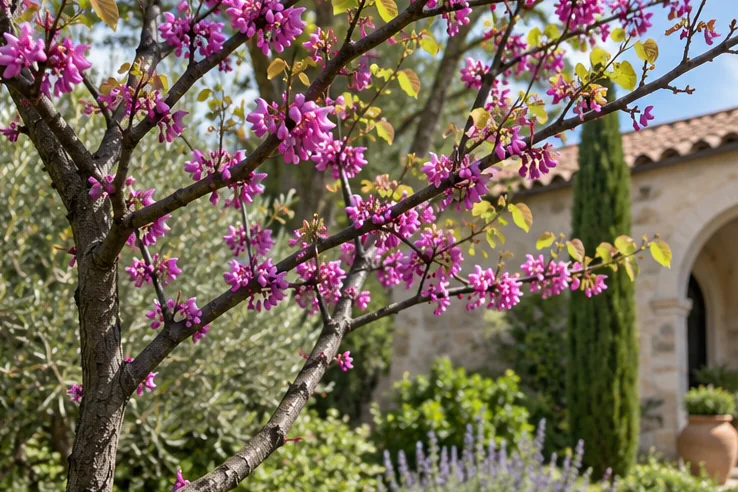
Choose a site with sun, good drainage and room for a broad crown if you want to grow Cercis siliquastrum. This small landscape tree, often called the Judas tree, has pinkish pea-shaped flowers on older branches before the canopy fills with leaves. It may also flower directly on parts of the trunk. Give the display enough space to be seen from a path or window.
Cercis siliquastrum is a Mediterranean-region species. Eastern redbud, Cercis canadensis, belongs to the same genus but has a different native range. The plants share a family resemblance, and common names can be loose. Confirm the botanical label and local cold suitability before you buy.
Recognize the tree through the seasons
Look for pink to purplish flowers clustered along bare branches in spring. Examine an older branch as well as the small outer twigs. The position of the bloom is part of the tree’s appearance. A specimen that shows its trunk clearly can put some of those flowers at eye level.
Rounded, heart-shaped leaves develop as the season advances. Check several from the same branch. The outline can be broad and blunt compared with a long pointed heart shape you may associate with another redbud. If you find an unlabeled tree, use the combination of flower placement, leaf shape and the flat pods that develop later. A source record or a local tree expert can help distinguish related species.
Pods can remain visible after the flowering season. Consider where they will fall if you are placing the tree beside a seat or walkway. A little seasonal litter may be easy to manage in a planted bed. Over a main entrance, you may prefer to keep the crown away from the narrowest crossing.
Leave space for the full-grown crown
Read profiles for the typical height and width, then sketch a generous crown on a plan of your yard. Mark walls, overhangs, nearby trees and places you need to reach. A Judas tree sold as a small specimen can still occupy much more space than a young nursery plant. Give the trunk and branches room to spread where they will need little adjustment as they age.
Observe direct light across the day. A bright open site can support the flowering display and help you see the branch shape. In a location with partial shade, consider how the amount of shade may change when nearby plants fill in. Ask about local performance if you are close to the cold edge of its recommended range.
Check how the ground drains across the area the roots will grow into. A dry top layer can cover wetter soil. Watch the area after persistent rain and see whether it receives runoff from paving or roof drains. A tree in a low wet spot can experience very different soil conditions from one a few feet upslope.
Establish the tree with regular checks
Buy a healthy nursery specimen and check its planting instructions. Plant at a suitable time for your local weather and soil. Follow local tree-planting guidance for the root ball and its relationship to the soil surface. Choose a time when you can return to check moisture regularly after the tree goes in.
Water after planting and assess moisture in the root ball and soil around it during establishment. These areas can dry at different rates. Weather, soil and the size of the plant all affect when you need to water. Let drainage and actual moisture guide your decisions. A consistently saturated site warrants attention to the cause.
If you use mulch, keep the base of the trunk clear so you can inspect it. Leave a usable space between mowing or trimming equipment and the tree. Check any supports or ties according to the nursery’s directions. As the tree establishes, watch for new growth and note whether symptoms are widespread or concentrated on one branch.
Prune with the flowering wood in view
The visible display comes partly from older branches. Before removing a branch, consider the space it occupies and its role in the tree’s structure. Remove dead, damaged or crossing growth only where you can do so safely and the cut solves a specific problem. Get advice for larger limbs, high cuts or an established trunk structure near a building.
A hard reduction can remove flowering wood and change the silhouette that attracted you to the species. Planning enough space at planting helps keep future cuts modest. If a few living shoots crowd a path, assess which branch is causing trouble before making a permanent cut in older wood.
Check what changes from one spring to the next
Photograph the tree during its first spring and again when it is in leaf. Record any damage after frost or wind and whether the buds were visible beforehand. If flowering is sparse, check the age, light and recent growing conditions before changing several parts of care at once. Bringing a few clear images and the plant label to a local nursery gives them more information than a description of the flowers alone.