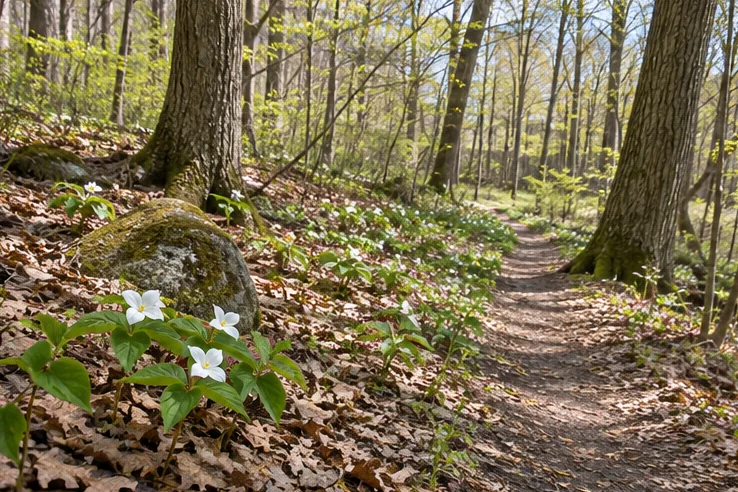
On a spring woodland walk, look at the forest floor before the branches overhead fill with leaves. In summer, return to check which plants remain visible under shade. A fall visit adds colored leaves and fruit. Bare branches, trunks and evergreen fronds can guide you through the same woods in winter.
These examples come from eastern North American broadleaf woods. Look in the habitat a plant favors, such as a moist stream terrace or a well-drained slope. The list works best as a guide to clues across several visits. Local guides can tell you which plants are common on your particular trail.
Early spring, when the ground receives more light
1. Bloodroot
Look for a white flower beside a folded leaf near the ground. As the leaf opens, its broad lobes are easier to see. The flower can disappear quickly, so photograph the whole plant and return to check the leaf later.
2. Spring beauty
This low wildflower has narrow leaves and small pale flowers often marked with pink lines. Search in open woodland patches before shade deepens. Short flowering stems can be easy to miss if you walk quickly over a path edge.
3. Trout lily
Look for mottled leaves low on the forest floor. A flowering plant may have a nodding yellow flower. Leaves are often easier to find than blooms, particularly where the plants grow together in a colony.
4. Virginia bluebells
Check moist woodland and floodplain edges for arching clusters of flowers. Buds can be pinkish and open blooms blue. Use leaf shape and the flower cluster together. A sunny patch in early spring may be deeply shaded on the next visit.
5. Trillium
Three broad leaflike parts arranged around an upright stem make a useful first clue for the genus. Flower shape, position and color differ by species. Observe the arrangement in place and use a local flora for a name more specific than trillium.
6. Mayapple
The umbrella-like leaves can form conspicuous patches. Look at how many leaves an individual stem carries and check beneath paired leaves for a flower. You may see the broad leaves well after the smaller early bloomers have faded.
Late spring and summer, when the canopy is full
7. Jack-in-the-pulpit
Look for a hooded structure in a shaded, moist spot. The hood surrounds a central spike, a flower arrangement that gives the plant its common name. Take a side view so you can see where the stem and leaf parts meet.
8. Solomon’s seal
The arching stem carries a series of leaves. Small pendant flowers can hang below them earlier in the season. Lower your viewpoint to see the underside of the arch and to distinguish the plant from others that carry a flower cluster at the tip.
9. American hornbeam
Look at the gray trunk of this small tree in lower or moister woods. Flutes along the trunk resemble the shape of muscles beneath skin. Check the leaves and twig as well, since bark alone can be misleading.
10. Tulip tree
Watch for fallen leaves with a broad outline and a shallow notch at the tip. Leaves at eye level may belong to younger trees while mature trees carry their crowns overhead. Where flowers are visible, their upright cup shape gives another useful clue.
Fall, when color and fruits become easier to notice
11. Sugar maple
Look for opposite branching and lobed leaves. Leaf color varies with the tree and conditions, so check several leaves and the branch arrangement. A sunny edge and a shaded trail can show different degrees of color on the same visit.
12. White oak
White oak often has rounded leaf lobes. Acorns beneath a tree give you another detail if you can match them with attached leaves or fruit still on the branches. Keep in mind that leaves and acorns can come from several trees around one bend.
13. Virginia creeper
Look for a vine with five leaflets on many mature leaves. It may climb high into another plant or trail across the ground. In fall, changed leaf color can help you follow the vine back to its branch or trunk support.
Winter, when a few features stand out
14. American beech
A smooth gray trunk and long narrow pointed buds are useful winter clues. Young stems may hold dry tan leaves for part of the winter. Compare a branch tip and the trunk to make a stronger identification.
15. Christmas fern
Look for evergreen fronds near the forest floor. Each leaflet can show a small projection near its base. The fronds may hold green color after the canopy drops its leaves, making a clump easier to locate from the trail.
Take the same short walk twice
Pick a route that passes at least two conditions, such as a drier rise and the lower ground near a stream. Photograph a whole plant and its most distinctive feature, then label the image with the month and habitat. Return when the light or season changes. When you recognize the same plant on a later visit, you can start to connect the flowers you saw in spring with its summer leaves or winter buds.