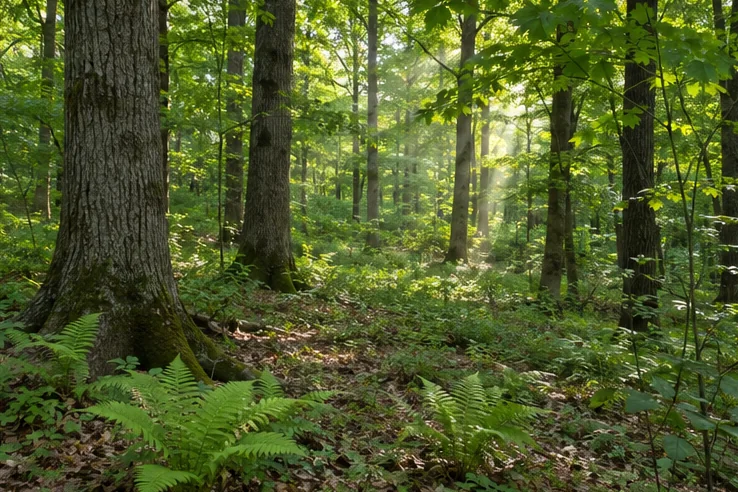
Look up into the canopy, then work your way down to the small trees, shrubs and plants around your feet. A maple may occupy the highest layer while a flowering dogwood grows in the same patch of woods beneath it. Each plant gives you a different clue about light, moisture and the time of year.
These 16 examples come from eastern North American deciduous forests. A deciduous tree sheds its leaves seasonally. The term describes the dominant canopy in these forests, where you may also encounter evergreen plants and herbaceous species with soft stems. The plants you find will vary with latitude, elevation and soil. You might see several of these on one trail and a different mix a few ridges over.
Canopy trees
1. Northern red oak
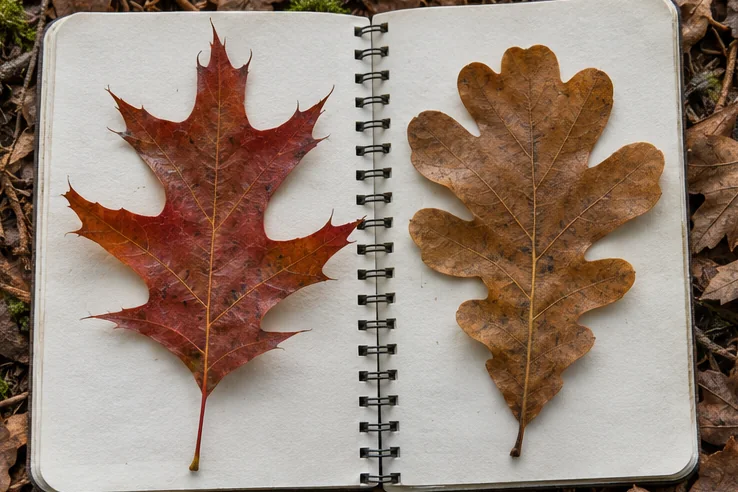
Look for bristle tips at the ends of the pointed leaf lobes. If you find leaves and acorns on the ground, compare them with material on a low branch when possible. Leaves can drift across the trail, and several kinds of oak may share the same slope.
2. White oak
White oak leaves usually have rounded lobes, a useful first difference from northern red oak. The depth of the cuts between lobes varies. A branch with several leaves gives you a better sample than a single unusually shaped leaf from a sapling.
3. Hickory
Hickory leaves are compound. Each leaf contains several leaflets along a common stalk. Look for the point where that stalk attaches to the twig, then check the ground for hard nuts or split husks. The details of the leaflet arrangement and husk help narrow the species.
4. Tulip tree
Tulip tree has a broad leaf with a squared or shallowly notched tip. A tall specimen often has few low branches, so fallen leaves are useful clues. In flower, the upright cups can sit high enough that you need binoculars to see their shape.
5. American beech
A beech trunk often has smooth gray bark, and the leaf has straight side veins ending at fine teeth. Younger trees may retain dry tan leaves into winter. Check a twig for slender pointed buds, especially when fallen leaves from several species are mixed together.
6. Sugar maple
Look for opposite leaves or branches and broad leaves with several pointed lobes. Compare several leaves before deciding between maples. A forest-edge tree in full light can have leaves that look different in size from those on a shaded sapling below the canopy.
7. American basswood
Basswood leaves are broadly heart-shaped and usually unequal on the two sides of the base. Check for teeth along the edge. A narrow, pale bract, a modified leaf attached to the flower or fruit stalk, can help confirm the identification when it is present.
Small trees in the understory
8. Flowering dogwood
Flowering dogwood often spreads its branches into tiers below taller trees. In spring, the familiar white display comes from bracts around a cluster of small flowers. Later in the season, look for opposite leaves with veins that curve toward the tip.
9. American hornbeam
Hornbeam can look like a cluster of gray stems until you get close enough to see the fluted trunk. Those ridges give it the nickname musclewood. Look for this small tree near moist slopes and stream terraces, where the canopy may still be high overhead.
10. Pawpaw
Pawpaw has large, elongated leaves that often hang down at the edges of a patch. Several stems may grow close together. Step back to trace the outline of the entire patch, then look at where the leaves attach to a twig.
Shrubs and vines
11. Spicebush
Spicebush often grows in the shade of moister woods. Its small yellow flowers appear on bare branches in early spring. At other times, use the simple, smooth-edged leaves and branching habit as clues, then confirm the plant with a local guide.
12. Mapleleaf viburnum
The lobed leaves of this low shrub resemble small maple leaves. Check how the stems emerge from the ground and look for clusters of flowers or fruit. You may find the shrub well below the crowns of the maples its leaves resemble.
13. Virginia creeper
Virginia creeper can trail along the ground or climb a trunk. An established leaf typically has five leaflets. Follow the flexible stem and check its attachment before assuming the foliage belongs to the tree that supports it.
Plants on the forest floor
14. Bloodroot
In early spring, a pale flower may appear beside a folded leaf close to the ground. The leaf unfurls into a distinctive rounded, lobed shape. View it in place, since pulling up a plant removes the underground parts that support future growth.
15. Spring beauty
Look for low flowers with fine pink lines on pale petals above narrow leaves. Spring beauty takes advantage of the brighter weeks before the canopy fills in. A patch along a path may look sparse by the time the trees cast deep shade.
16. Christmas fern
Christmas fern has long divided fronds that can remain green through winter. Look for the small upward projection near the base of each leaflet. Winter greenery is a useful clue in woods with a largely leafless canopy.
A way to verify your observations
Photograph a whole plant, a leaf where it joins the stem and one feature such as bark, buds or a flower. Record whether it grew on a dry ridge, a moist slope or a streambank. These details let you compare a plant with regional guides and see how the layers change as you walk.