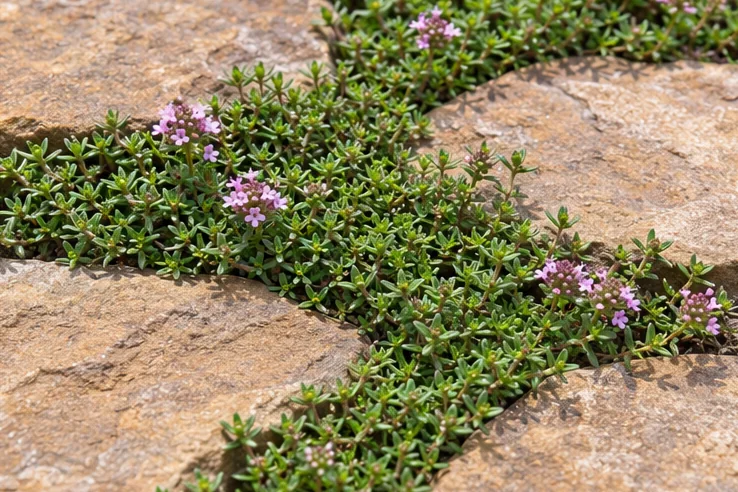
Give elfin thyme a sunny, freely draining surface where its small leaves can form a low mat. It can fit alongside paving or at the front of a container. Plan foot traffic around it. Occasional careful access and repeated trips over the same narrow patch put very different demands on a plant.
Elfin thyme is a trade name used for compact creeping thyme. This guide focuses on Thymus serpyllum ‘Elfin’ as listed by the Royal Horticultural Society. Keep the cultivar label and compare how your plant grows. Other low thymes sold under similar names can differ in spread and local cold tolerance.
Decide where the mat will have space to spread
Look at the purpose of the planting first. Beside a step, you may want a small patch that stays low without slipping into a heavily used route. At the edge of a bed, you may want to see a band of fine foliage in front of taller plants. In a container, see whether its neighbors will eventually shade it.
Measure the actual planting gap at the surface and check how deep the growing pocket goes. A narrow gap filled by compacted debris may offer little space for roots or water movement. Choose a place that can take suitable growing material and let the small root ball fit without forcing it into the opening.
Watch how direct sunlight changes across the season. An open path can become shaded after shrubs grow into it. Look for a position suitable for thyme where the foliage can dry after rain. In a tight pocket, constant moisture around the crown can be a bigger concern than the available surface area.
Plant into a pocket that drains
Use sound young plants with a root ball sized for the location. Provide well-drained material and set the plant so its leafy base stays appropriately exposed. Water it in and watch how the moisture leaves the pocket. If water pools on the top or sits around the base, reconsider the drainage.
For a container, choose drainage holes and a potting mix appropriate for herbs that need good drainage. Keep the pot where you can reach it and see the plant’s center. A shallow pot can dry quickly when wind and sun are strong. Its plants may need more frequent moisture checks than established thyme in the ground.
A paving joint can also dry early at its edges while still remaining damp deeper down. Check the soil with care instead of judging only by the color of the surface gravel. Compare the thyme with the other plants along the same path if you want to see which positions dry first.
Water while new roots establish
Check the root area regularly after planting and water as needed while roots spread. A newly planted plug has a limited root system. A place that suits an established mat can still dry too quickly for a small plug during a hot spell. Stop and check the soil if leaves begin to wilt.
Once the plant has filled its pocket, check the root area again before deciding how often to water. Look for fresh growth extending over nearby soil or stone. During cool or rainy weather, the medium may stay moist longer than it did earlier. Adjust your checks based on that change.
Do not cover the center with wet debris as you tidy the path. Lift accumulated leaves if they are smothering the foliage. Check whether runoff from a roof or regular watering of nearby plants leaves the thyme repeatedly wet, especially during winter.
Ask how the walking route will be used
Put the main stepping surface where people naturally walk. Place thyme beside the stone or in gaps it will not be stepped on constantly. Observe the route on a busy day before planting several patches. Corners where people pivot and places where wheels pass can be difficult for a small living mat to occupy.
Occasional stepping is a different use from treating elfin thyme as a replacement for a frequently traveled lawn or path. Look for gaps in the mat, crushed growth and areas where the soil has compacted. If damage is concentrated in one route, move the stepping surface or adjust the planting.
Trim only the part that needs attention
If growth crosses a place you want to keep clear, make a small trim along the edge. Check that healthy leafy shoots remain. A small plant recovers more readily when it can keep much of its growth, and a selective trim preserves the low shape.
Inspect the patch after its first winter. Look at how the surface drained and which parts retained healthy growth. If it thinned where water stood or people stepped repeatedly, adjust the site before replacing the plant. A sunny pocket with stable drainage and a sensible walking route gives the small mat room to fill out.