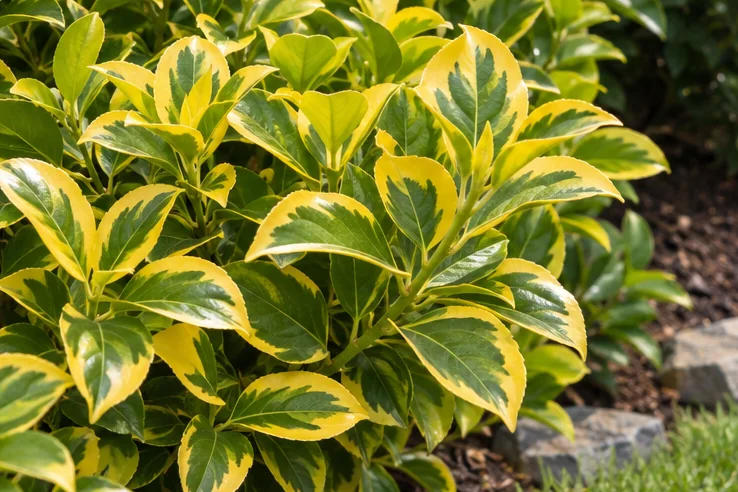
Choose golden euonymus for a spot where the yellow leaf margins will be visible and the shrub can reach its mature width. The plant commonly sold under this name is Euonymus japonicus ‘Aureomarginatus’, an evergreen Japanese euonymus selection. Its green leaves have broad yellow edging. Confirm the tag, because the genus includes other species and variegated shrubs with different habits.
Give the plant suitable light and drainage. Water a new planting while the roots establish, then prune according to the space and shape you want. A specimen beside a dark fence can be maintained differently from several shrubs grown as a clipped screen.
Measure the space before choosing the form
Look up the mature height and spread for the named cultivar at a nursery familiar with your region. Draw the approximate size around the proposed planting spot. Mark walkways, windows and the space you need to reach behind the shrub. The label size tells you more about a hedge than the shape of a plant that has been sheared for sale.
For a specimen, visualize how the yellow edges will stand out against the background. Dark foliage or shadow can make the margin easy to see from a distance. A spot with deep shade may change the strength and appearance of the growth. Observe how the area is lit during the period when you use the garden most.
For a hedge, decide whether the aim is a continuous clipped surface or an informal edge. Give the plants room for the expected habit and a clear route for maintenance. Check local guidance before buying several. Rules and recommendations about euonymus may apply to particular species, so compare the botanical name with the local guidance.
Establish the roots in suitable soil
Look after rain to see where water collects. If irrigation runs down a wall or hard surface beside the planting, check the soil near the prospective root ball. Local conditions will help you decide what drainage the plant actually receives across the season.
Set a healthy nursery plant according to local recommendations for planting shrubs. Water it in and check the moisture of the original root ball while new roots grow. In the first part of establishment, the potting mix can dry before the soil beside it. Check both before setting an interval.
As the plant grows, adjust watering to weather and soil. A shrub growing near warm paving can experience a different drying pattern from one near a protected wall. Note changes in moisture before treating yellowing, wilting or slow growth. The gold on the edges is a cultivar trait. If the entire leaf starts to yellow, inspect the roots and growing conditions separately from the normal gold edges.
Make cuts that preserve the variegated growth
Prune lightly to fit the plant to the available space. Follow a shoot back to where you can make a selective cut. A few cuts can clear a path or open a crowded section while keeping much of the outline. For a clipped hedge, use a rhythm that leaves enough healthy leafy growth and lets you inspect the interior.
A fully green shoot whose leaves repeatedly lack the cultivar’s pattern may be a reversion, a change back toward the parent plant’s foliage. Examine several leaves along the shoot and compare them with healthy growth elsewhere. If the green shoot is clearly reverting, trace it to its origin and remove it there. Watch the plant over time, as individual leaf color can vary with exposure and development.
If the shrub needs constant hard cuts to stay in its spot, reconsider the space. Moving an established plant involves its own timing and care. It may be simpler to replace it with a smaller shrub when the job is large. Consider the footprint and access before making that decision.
Look closely if the leaves show specks or decline
Euonymus scale can appear as small fixed coverings on leaves and stems. NC State and Clemson describe different appearances for the insect’s forms. Use magnification or a clear photo to see whether pale marks are insects, dust or something else. Record whether they are concentrated on a branch or spread across the hedge.
Check both sides of the leaves and the places where new shoots join older branches. Scale can be harder to notice inside a dense shrub. Seek local identification and guidance before applying a treatment. The type and stage of the pest matter when choosing an approach.
NC State Extension lists several parts of this cultivar, including its leaves and fruit, as potentially harmful if eaten. Keep clippings away from children and pets. If someone may have swallowed plant material, contact Poison Control. If a pet may have eaten it, contact a veterinarian or animal poison service.
Review the shrub after a full growing season
Photograph the plant from the usual viewing angle. Check the distance to the walk, the foliage at the base and any change in color along shoots. Pair that record with observations of drainage and pest signs. A good location leaves room to see the gold edging and reach the shrub when light pruning or a close inspection is needed.