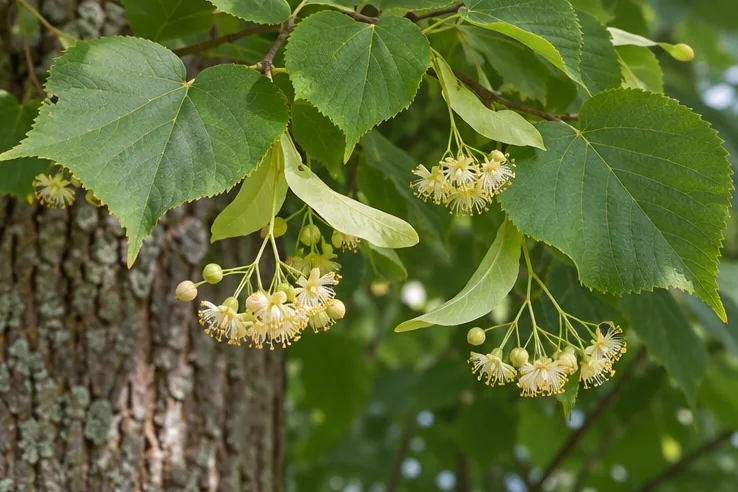
Look for a broadly heart-shaped leaf and a narrow pale bract attached to a flower or fruit stalk. That pair of features is a good reason to consider linden, a tree in the genus Tilia. The bract is a modified leaf that extends along part of the stalk. It can be visible when flowers or fruits are present and gives you a clue beyond the shape of a leaf.
Lindens take several forms, from native American basswood to widely planted littleleaf and silver lindens. Compare several mature leaves, the two leaf surfaces and any flower or fruit structures. Bark helps put a tree in context, especially in winter, but it varies with age and growing conditions.
Make sure you have a linden leaf and twig
Choose a branch where you can see the order of several leaves. Most have toothed edges and a base that is often unequal on the two sides. One side of the base can extend farther down than the other. Take a photo of several leaves at their normal position and add a close view showing the margin and vein pattern.
Check the underside in good light. It can look lighter than the top on several species. The details matter. Look for pale hairs across the surface and small tufts where veins join. Include scale in at least one photo. A large leaf on a vigorous young shoot may differ from the more typical leaves on an established branch.
Scan for a cluster of small flowers or a few rounded fruits with the pale straplike bract. Look at how the bract connects to the stalk. Take a picture from an angle that shows both structures. If everything is too high, a close photo through a zoom lens or material freshly fallen below the crown can help. Check whether fallen material could have come from a neighbor.
Compare three common linden types
American basswood, Tilia americana. This North American species often has large leaves with an uneven heart-shaped base. Check the leaf size and texture across several mature leaves. A broadly spreading tree in eastern or central North America can be a candidate, though native range and site alone cannot confirm it.
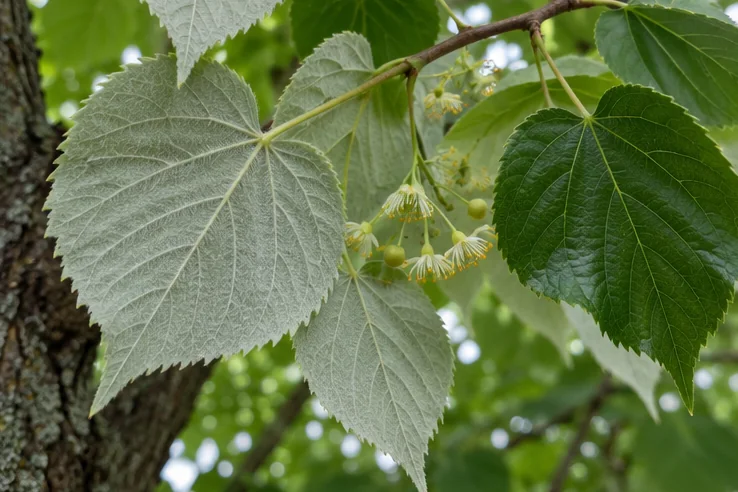
Littleleaf linden, Tilia cordata. A frequently planted species with relatively small heart-shaped leaves. Look at the leaf undersides and whether small tufts of hairs are visible in vein angles. A dense street or garden tree can have leaves easier to inspect near the outside of the crown than inside shaded growth.
Silver linden, Tilia tomentosa. Look for the conspicuously pale, silvery lower leaf surface produced by dense hairs. In a breeze, several turned leaves can show a flash of that lighter color. Take a close view of the whole underside to distinguish a uniformly pale surface from a few small pale patches.
Compare those clues with a botanical key, which helps you narrow a name by making a series of choices. Lindens sold for landscapes can also include hybrids. A nursery tag or planting record provides useful evidence for a tree that does not line up neatly with the typical features of one species.
Read the bark in relation to tree age
Look close to the base, at the main limbs and at younger branches. Younger linden bark can be smoother, while older bark can develop ridges and furrows. Some parts of an older tree can still look fairly smooth. Sun, weather and past damage can alter what you see around a trunk.
Where a tree is leafless, photograph the full trunk, a section of bark and the end of a small twig. Make a note of the position and look for attached fruiting material. Check the tree again when leaves emerge. A bark photo can help someone narrow an identification while several leafy details usually make the conclusion stronger.
Mark the seasons when evidence is clearest
Look for the small flower clusters against the leaves, or check the ground beneath the crown for one that has fallen. Flower timing depends on species and region. The bracts and then the rounded fruits can remain useful as the season changes. In fall, compare the leaf underside while you still have usable foliage.
For an unfamiliar street tree, note its address or position and check for a municipal tree inventory. The record can provide a planted name to compare with your observations. For a tree in a natural area, see which Tilia species are documented locally and ask a regional expert how the local key handles variation.
Bring at least one picture of a whole branch, one of a mature leaf underside and one of any flowers, fruits or bracts. A group of pictures of the same tree usually gives you more than a single bright yellow fall leaf. Use the name that the combined evidence supports.