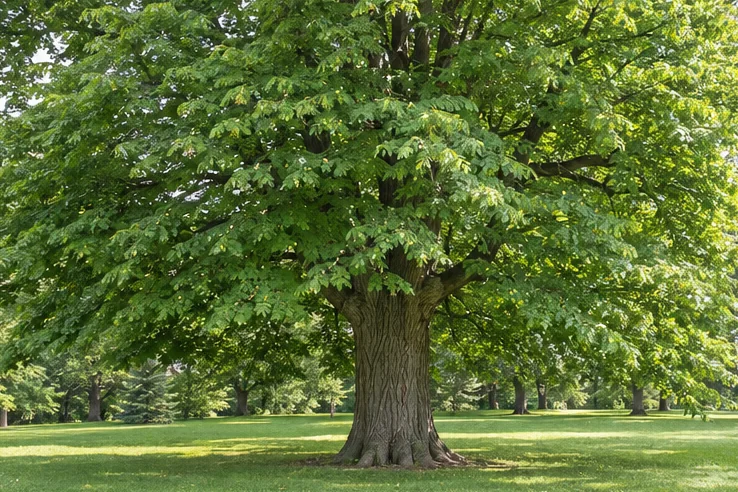
American basswood, Tilia americana, is a large deciduous shade tree native to parts of eastern and central North America. Look for broad, toothed leaves with an uneven heart-shaped base. The small flowers and round fruit attach to stalks with pale straplike bracts. Those features together are more useful than trunk appearance alone.
If you are considering a planting, draw the mature canopy first. An American basswood can occupy a substantial part of a yard. Think about the shade it will cast, where its branches can spread and whether the soil, water and local conditions are suitable for a large tree.
Confirm the species before you make a site plan
Look for alternate leaves along a twig. The leaf blade can be large with a pointed end, a toothed edge and an unequal base. Examine several leaves at the same stage of growth. A large leaf from a vigorous shoot may tell you less about the usual mature size than several leaves taken in context.
From late spring into summer, where conditions and timing permit, examine flower clusters. The flowers are small and can be pale or yellowish. A long pale bract is attached to the cluster stalk. The same detail can remain useful as fruit develops. Use the label, regional identification information and these visible features to distinguish basswood from other planted lindens.
Older bark can be furrowed. A close-up of bark is helpful alongside other parts of the tree. For a bare tree, photograph a small twig and look for last season’s fruit or bracts. Return in the leafy season to check the underside of a mature leaf if the identity is still uncertain.
Think about the entire mature crown
Check regional profiles for the likely height and spread of the tree. Typical figures depend on growing conditions and the source. Mark where the crown would extend in several directions. Include property boundaries, roofs, utility lines, patios and nearby trees. If an existing low-branched tree would take up the same light and air space, consider the future overlap.
Observe where you want shade at the time you normally use the yard. A tree placed on one side of a patio can give a different shade pattern from a tree planted right beside it. Watch the sun’s path and decide whether the projected canopy helps. A vegetable bed that needs light can be affected as the tree grows. A slender nursery tree gives you little sense of how much of the vegetable bed might end up in shade.
Look down at the planting site too. The space available to roots and the conditions they encounter matter. A small strip with compacted soil is different from a broad yard or park setting. Discuss large tree placement with a local arborist if there are structures or utilities close to the proposed site.
Choose a soil and exposure the species can use
American basswood grows in a variety of regional woodland settings, especially sites with suitable moisture and soil. Read the profile for the plant you are buying and check what the area does after rain. Look for soil that can supply water without staying saturated. Explore how deeply the site is affected by nearby paving or heavy use.
Compare sunlight now with how it could change. Existing shade, future construction and neighboring trees can affect establishment. Consider wind exposure as well. If you are planting at the edge of the species’ regional range or in an unusually exposed spot, ask about locally successful plantings.
Choose a sound nursery tree with an identified source. Follow appropriate local guidance for tree planting and establish a plan for checking the root ball after installation. The soil in a root ball can dry at a different pace from surrounding soil. Water when needed during establishment and observe whether light and moisture reach the new growth.
Place the tree with shade and cleanup in mind
Consider where flowers, leaves and fruit will fall. A spot beside a parked car or an outdoor dining area may need more frequent seasonal cleanup than a tree in an open planted area. Aphid activity can also lead to sticky honeydew below lindens in some situations. If you see it, confirm the cause before making a pest decision.
Plan access around the mature tree. Keep good sight lines and enough space to get past trunk and branches. If substantial pruning would be necessary to retain clearances, choose a more suitable location while the plant is still small. For an existing mature tree close to a building, a qualified arborist can evaluate the structure and discuss maintenance.
Give yourself a record of the site and tree
Keep the botanical label, the planting date and a picture of the whole tree with its surroundings. Take another picture once the canopy is in leaf. Note shade, drainage and the position of any conflicting branch. The record is useful as the tree grows toward the dimensions you planned for. Revisit your early sketch when deciding where to place other plants or garden features.