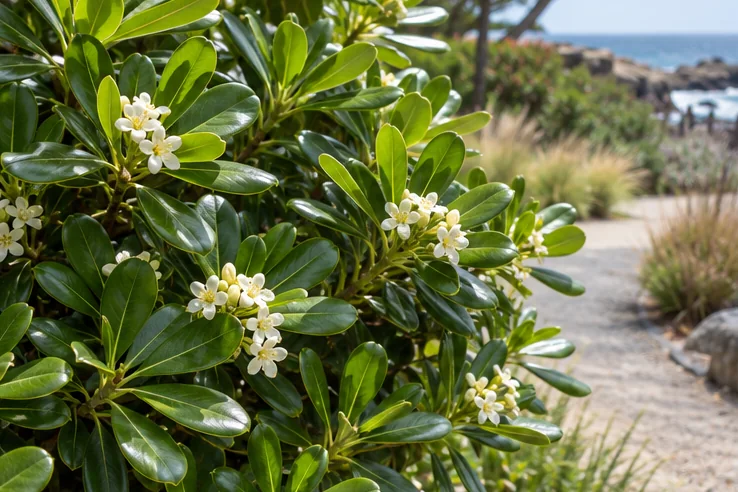
Japanese mock orange, Pittosporum tobira, has glossy leaves and clusters of fragrant pale flowers. Choose it according to how much space you have and whether you want a full shrub, a low mound or a plant with variegated leaves. The straight species and the dwarf forms can take up very different amounts of room.
Give the shrub a site where the roots can drain, and check its cold suitability for your area. Coastal tolerance, winter hardiness and a plant’s ability to cope with wet soil are separate questions. Check each one for the conditions it will face.
Compare the straight species and named varieties
The straight species can grow into a substantial broad evergreen. It may suit an informal screen with enough width. Look for glossy leaves crowded near shoot tips and fragrant flower clusters when it blooms. Check the height and width given for your region before laying out the screen.
‘Wheeler’s Dwarf’ has a low, mounding habit. It can work below a window or near a walk where a tall shrub would obstruct the view. It still needs width and a position that allows access around it. Compare the expected spread with the distance from the wall to the walk, and include those same distances on your plant plan.
‘Variegata’ has light margins on green leaves. Plan where the leaf contrast can be seen, such as against a darker wall or in front of solid green foliage. Check the specific label and size expectations. A leaf description gives you the color, while the cultivar name helps you find the habit and eventual dimensions.
Match the planting spot to the conditions it offers
Look at direct light and the change in shade over a season. UF/IFAS documents the species growing in sun and part shade. In a bright sheltered position where it flowers, place it close enough to enjoy the fragrance while allowing for its eventual spread. A deep overhang can affect light and the amount of rain that reaches the root ball.
Check drainage after natural rain and regular irrigation. Standing in water can damage roots even where conditions above ground seem suitable. If lawn irrigation sends water over the bed frequently, see how wet the soil remains before adding an evergreen that needs drainage.
In coastal areas, consider exposure to salt spray, wind and the actual soil conditions separately. The species has some tolerance of coastal exposure according to UF/IFAS. Local examples are useful for deciding which plant can handle your specific site. A shrub flourishing behind a wall may face milder conditions than one on an exposed boundary.
Check regional planting guidance, particularly where the plant is non-native. UF/IFAS maintains an assessment for Florida that uses geographic categories. Consult the current entry for the part of Florida where you garden. Outside Florida, look for local resources that address the species and the habitat near your yard.
Get the roots established
Buy a well-labeled plant, and follow nursery and local advice for setting the root ball at the right level. Water after planting. In the first weeks, check the moisture of the nursery mix and the surrounding soil. If one holds moisture longer than the other, adjust when and where you water.
As growth fills the space, pay attention to light and air along the base. Leaves hidden by crowded neighbors are hard to inspect. Keep an accessible edge so you can look for stress or maintenance needs without pushing through other plants.
For container use, select a form whose eventual dimensions fit your plan. Match the pot to the roots and provide practical drainage. Check the medium between waterings. A plant in a pot beside hot paving may need water checks sooner than one growing in the ground where the roots are cooler.
Prune according to the shape and flowers you want
An informal shrub may need just a few selective cuts to remove damaged branches or improve access. Look into the plant to find where the problem shoot joins older growth. That point helps you make a cut that fits the natural outline. For a formal hedge, follow a light maintenance rhythm and provide room to reach both sides.
If fragrance matters, plan shaping after the main flowering display when possible. Repeated clipping can remove the shoots or buds that would contribute to flowers. For a dwarf shrub below a window, check which specific branch needs attention before taking the whole top down.
A variegated plant may produce a shoot with a different appearance. Compare it with older growth and verify the plant’s identity. If one shoot is clearly reverting and beginning to outgrow the rest, removing it at its origin is more selective than shearing all the light margins back to the same height.
Review the plant at the end of the season
Look at the amount of space the shrub filled, where it flowered and how the soil dried. If a low form is starting to reach a path, assess the longest shoots while they are manageable. If you see widespread leaf decline, check the root area and exposure before adding fertilizer or making large cuts. The goal is a healthy plant that fits the space you measured.