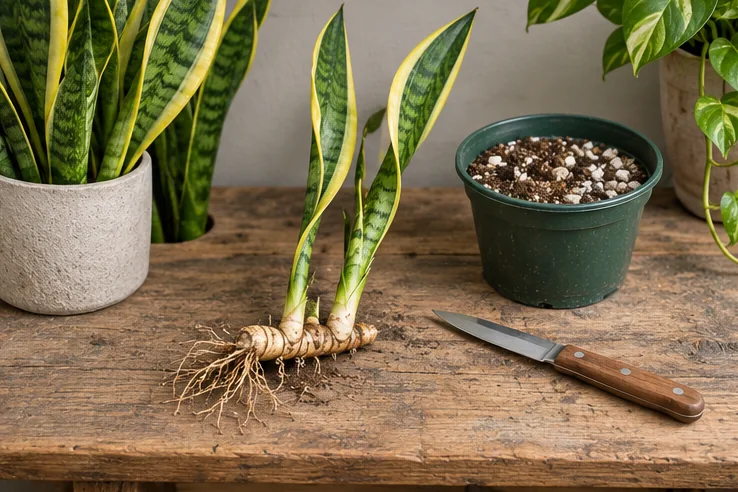
Divide a snake plant if you want to carry the parent’s variegation into another pot. Use leaf sections if you want to make several new plants from a healthy leaf and are comfortable with the possibility of green growth. Both methods start with a sound plant and a medium that drains freely.
The common upright snake plant is Dracaena trifasciata, still widely labeled Sansevieria trifasciata. It grows from rhizomes, horizontal stems that connect shoots. Division preserves a piece of that existing plant. A leaf section has to form roots and develop a new shoot from the cutting.
Pick material suited to the job
Look for firm leaves and healthy new growth. If you want to divide the plant, check whether it has distinct shoots with connections beneath the soil. A small shoot well away from the center may have roots of its own. You will see how it connects after you lift the root ball.
For leaf cuttings, choose a firm leaf without soft areas or obvious damage. Think about how much foliage the parent will retain. Removing one sound leaf from a large plant is a smaller change than taking the only mature leaf from a young offset.
Yellow edges and other patterns can be lost with a leaf cutting. Division is the more dependable method when the appearance of a particular plant matters. Label the pieces before they start to look alike, especially when you are working on several varieties.
Divide along the existing shoots
Prepare a clean cutting tool, pots with drainage holes and a suitable succulent potting medium. Take the plant out of its container and gently remove just enough loose mix to see the rhizomes and roots. Identify the section you want to separate and check that it has viable growth and some roots.
Use your clean tool to separate the connection where needed. Keep the healthy roots and growth on each piece. Try setting a division in the planned container before adding soil. The roots should fit without being sharply bent, and the pot should leave a manageable amount of space around them.
Set each section at a depth appropriate for the way it was already growing. Work the medium around the roots and let the plant sit upright. Check that the holes are clear. Manage water carefully after root disturbance and according to the condition of the mix and division. A plant with a smaller new root system will use less water than the original clump.
Keep the right end down on a leaf section
Iowa State Extension uses healthy leaf sections 3 to 4 inches long. Mark the bottom edge of each piece as soon as you cut it, before the pieces get turned around. You can use a consistent cut shape or other marking system. The original lower end goes into the medium. This direction is called polarity.
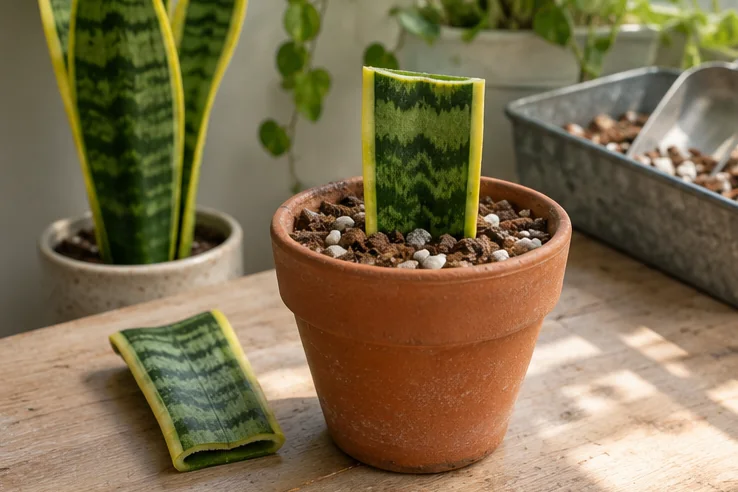
Arrange the sections so you can keep them in that order while preparing to plant. Set each section into moist, well-drained propagation mix with the original lower edge down. Keep enough of the cutting exposed to check whether the leaf stays firm and upright as it roots.
Label the pot with the parent plant and the date. Keep it in bright, suitable light and check the medium so that it can support rooting without staying saturated. A small section in a pot with no roots has little immediate demand for water. Inspect the base if it becomes soft or discolored.
Wait for evidence of growth
Rooting and new shoots take time, and conditions affect the interval. Watch for firm cuttings and later for a shoot near the base. Avoid repeatedly pulling pieces out to check progress. If you have sections from several leaves, one piece can begin growing before another in the same space.
Give a young plant enough root and shoot growth to handle a move. When potting it up, choose a container suited to its small root system. Keep the mix open and change your watering as demand changes. Keep a label with the plant if you want to compare mature color patterns later.
A divided plant may show progress sooner because it already has a shoot and roots. Check that it stays firm, that the pot dries appropriately and that new growth appears when conditions suit it. Plants in different rooms can progress at different rates even if they came from the same clump.
Compare the results before repeating the method
Record the method, the source plant and the first sign of new growth. If a leaf section from a yellow-edged parent produces a green shoot, the cut still made a viable plant. For a future plant with the parent’s pattern, use an offset or a division. The difference between those outcomes is what makes choosing the propagation method worth doing first.