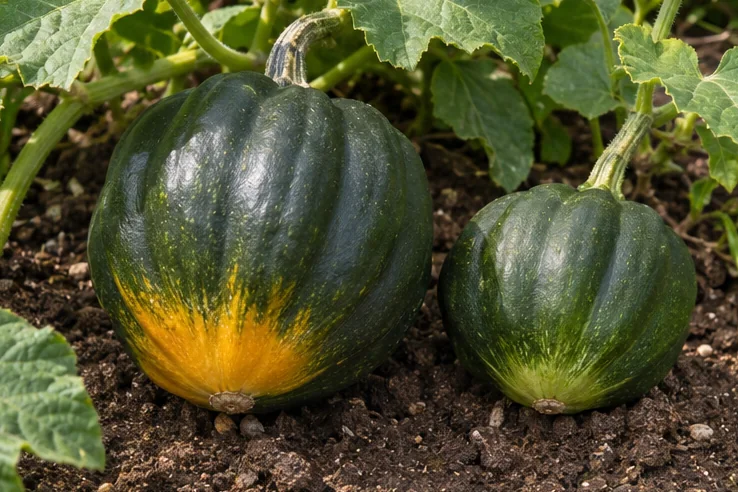
A ripe acorn squash usually has a tough rind, a surface that has lost some of its early gloss and mature color for its variety. Many traditional green types also develop a golden-orange patch where they rested on the ground. An immature fruit can already be dark green while its rind and ground spot are still developing. Compare several traits before you decide which stage you are seeing.
A ripe squash and one that still needs time can look surprisingly similar at first. Start with what you know about where and when the fruit grew. A squash still attached to a healthy vine gives you a chance to watch it change. One already at the market needs to be assessed from its current condition and the information available there.
Rind changes from easily marked to firm
As the fruit matures, the rind hardens. A fully developed acorn squash generally feels sturdy over the ribs and the spaces between them. Early rind may be softer and more easily marked. Extension guides describe this hardening as an important cue for winter squash in general.
Handle food gently when you inspect it. A firm, intact surface is the one you want for storage. The outside should retain its shape under normal handling. Leave the rind unbroken for any fruit you plan to keep. At a shop, visual inspection and a gentle feel are more appropriate than trying to mark produce.
A soft area on a stored fruit can reflect damage or spoilage. Check whether the softness is widespread or concentrated in one bruised, leaking or moldy area. If the rest of a fruit feels solid and the spot is falling apart, treat that as a condition problem. A single soft patch supplies little evidence about how early the fruit was picked.
The ground spot can deepen in color
A common green acorn squash can look mature on top well before harvest. South Dakota State Extension describes a golden-orange ground spot as a harvest cue for acorn types. Look for the spot on the side that has been against the soil, rather than assuming any orange area serves that purpose.
If a fruit grew supported off the ground, it may have a less obvious contact patch. A lighter-colored or patterned variety can also look different from the classic dark green example. Use its label and normal mature appearance. Check the rind and the stem together if you have little information about the variety.
Keep a photo of the same green fruit over a few visits while it is still growing. Include the ground contact side if you can see it without twisting the stem. You may notice the patch becoming stronger while the top looks almost unchanged. That is more informative than comparing two unmarked fruit from different plants.
The stem gives context for a garden-grown fruit
On a maturing winter squash, the stem can become drier and more corklike. A fresh green stem paired with a rind that still yields suggests the fruit may have more development ahead of it. Stem damage, drought or a failing vine can complicate the picture. Look over the plant as well as the part attached to the fruit.
For a fruit already cut loose, check whether the stem is intact and whether the rind around it is sound. A broken stem is a handling concern. It offers limited information about when the fruit reached maturity. Read the other traits before treating the stem as decisive.
A seed packet’s maturity estimate can tell you when to begin checking, especially if you wrote down planting dates. Growing conditions can speed up or slow development. Look at the plant, the rind and the variety’s color as the estimate approaches.
Early and mature fruit can cook differently
An immature winter squash may have less developed flavor and a different texture from a mature one. A fruit harvested early is generally a less suitable candidate for extended storage. Separate it from the group you expect to hold and check its condition promptly. Discard fruit with visible mold, leakage or clear decay.
Iowa State Extension advises against the warm curing process for acorn types because it can reduce quality and storage life. Curing in this context means holding a harvested crop under particular warm conditions. Follow the crop-specific guidance for sound, mature fruit. Avoid applying a general rule for pumpkins or a long-keeping winter squash to acorn varieties automatically.
Compare a few clues in a fixed order
Start with the condition of the rind. Look at the cultivar color and, if there is one, the area where the fruit rested. Check the stem and whether you know how the vine was doing. If a sound fruit remains on a healthy plant and weather allows, repeat the inspection when several cues are still developing.
When several fruits arrive indoors together, group them by confidence in maturity and by condition. Inspect the sound, mature batch regularly and use weaker candidates earlier if they remain suitable. This keeps one patch of color from making a storage decision for the whole harvest.