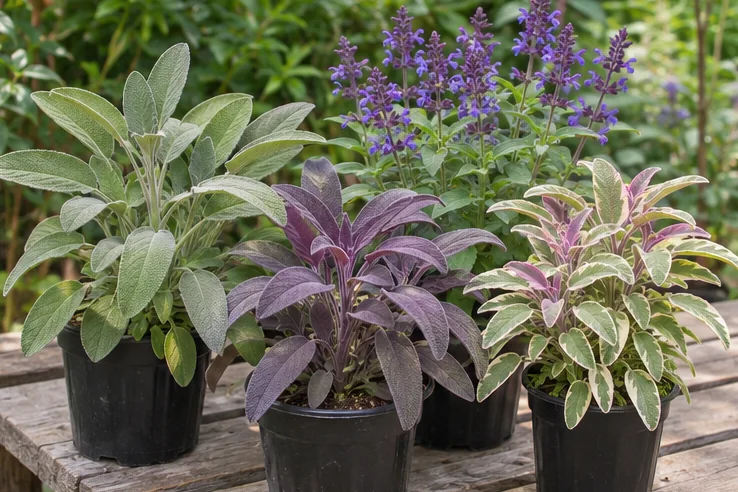
Choose a sage by what you want the plant to do. Common culinary sage belongs beside the kitchen herbs. For spring flower spikes in a sunny border, look for woodland sage. For a spot that stays damper, consider bog sage. Plants in the genus Salvia can have very different needs, even when all of them are sold under the name sage.
The list includes species and some named forms of the same species. A cultivar is a selected plant with a particular trait, such as leaf color. Botanical and cultivar names help when you are comparing similar-looking plants at the nursery.
Culinary sages and foliage selections
1. Common sage, Salvia officinalis
This gray-green, aromatic herb is the familiar cooking sage. Give it sunshine and freely draining soil. Place it where you can reach young leaves easily and where sprinklers from a nearby lawn will seldom keep the base damp.
2. Purple sage, Salvia officinalis ‘Purpurascens’
The purple color is strongest on new growth. It adds contrast beside green herbs and belongs to the familiar culinary species. Choose a bright, well-drained spot so you can see the foliage color clearly as the plant fills out.
3. Golden sage, Salvia officinalis ‘Icterina’
Yellow-green variegation makes the leaves stand out along a border edge. Use it as a foliage plant in a sunny herb bed or a pot with a drainage hole. Allow room around the low, rounded growth for air and access.
4. Tricolor sage, Salvia officinalis ‘Tricolor’
This selection has a mix of cream, green and pink tones. A container near a path makes the small leaves easy to see. Check winter hardiness for your garden and protect the plant from persistently wet soil.
5. Broadleaf sage, Salvia officinalis ‘Berggarten’
The wide gray-green leaves are easy to see and pick. Use this selection where you want a substantial foliage mound in an herb garden. Give it space to spread and the same good drainage you would provide for common sage.
6. Pineapple sage, Salvia elegans
Rub a leaf and you may notice a fruity scent. Red flowers make this an ornamental choice near a seat or path. In cold regions, plan for frost and check whether your growing season is long enough to see its later flowers.
Flower spikes for sunny borders
7. Woodland sage, Salvia nemorosa
Despite the common name, this border perennial performs well in sun. The upright flower spikes suit the front or middle of a bed. Check mature height on the selected form before mixing it with low edging plants.
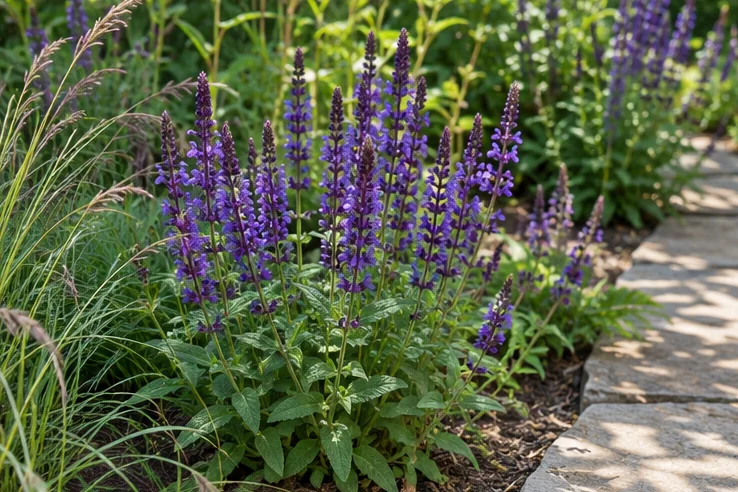
8. Meadow sage, Salvia pratensis
This flowering perennial fits a sunny, well-drained, meadow-style planting. Its upright stems rise above a clump of leaves. Allow light around the base so dense neighboring plants do not hide the flowers.
9. Mealycup sage, Salvia farinacea
The upright blue or violet flower spikes make good color in a seasonal bed. It is often grown as an annual where winters are cold. Use a sunny site and check the height of the cultivar you buy.
10. Mexican bush sage, Salvia leucantha
Soft-looking tubular blooms and colorful flower structures give this large sage a different texture from the shorter border species. Give it enough width to let the flowering stems arc and check local tolerance of winter cold.
11. Autumn sage, Salvia greggii
This shrubby sage fits sunny gardens with good drainage. Flower color depends on the selection. Use a nursery tag to choose a mature size that leaves room beside paths and walls.
12. Anise-scented sage, Salvia guaranitica
Tall shoots and blue-toned flowers work well behind smaller plants. Allow space and check winter hardiness locally. In cool climates, the growing season and exposure help determine the display you get.
13. Tropical sage, Salvia coccinea
Airy flowering stems work well in an informal sunny bed. Flower colors can vary among selections. Look for the botanical name when shopping because more than one sage is sold with a scarlet common name.
14. Bedding scarlet sage, Salvia splendens
This is the familiar compact bedding sage in many formal displays. Give it the light and spacing indicated for your selection. Buy for the flowers and habit you want at the front of a seasonal bed.
15. Baby sage, Salvia microphylla
Use this small shrubby species in a sunny place with freely draining soil. Check the label for variety size and local hardiness. The plant may occupy more width over time than its small leaves suggest.
Sages for distinctive sites and uses
16. Lyreleaf sage, Salvia lyrata
This eastern North American species has low leaves and taller flowering stems. Consider where its spread can be accommodated. Watch the edges of the planting if you want to keep neighboring small species visible.
17. Clary sage, Salvia sclarea
Large foliage and tall flowering stems give clary sage presence in a sunny bed. It is often grown as a biennial or short-lived plant. Leave room for the rosette, the first low whorl of leaves.
18. White sage, Salvia apiana
The silvery foliage suits a dry, sunny planting where climate and drainage fit. Choose nursery-propagated plants and allow for mature size. Persistently damp soil is a poor fit for this species.
19. Blue sage, Salvia azurea
Slender stems with blue flowers suit a sunny prairie-style planting. Pair it with neighbors that allow the stems to show and leave room for its habit. Confirm which native range and conditions apply in your area.
20. Bog sage, Salvia uliginosa
This tall, blue-flowering sage tolerates moister conditions than common culinary sage. Place it where its spread and height can be managed. A consistently damp border may suit it where a dry gravel bed would be a poor match.